
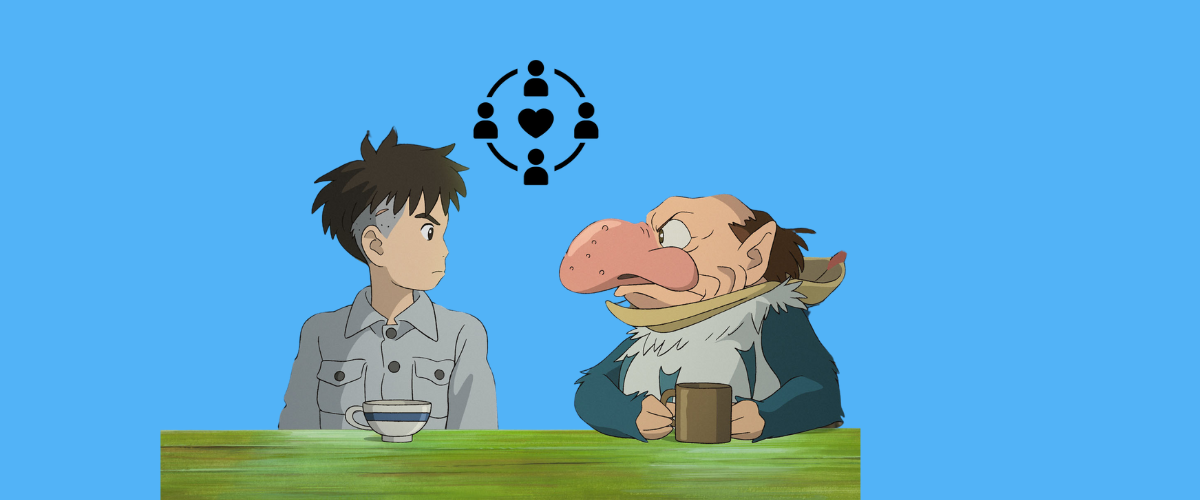
It’s no spoiler that Studio Ghibli’s latest film The Boy and the Heron starts with a mother’s death; that’s all over the ads. But how can you talk to kids about death and grief, and how hard is it to watch this movie if your parent or your child’s parent has died?

Miyazaki’s Goodbye to His Grandchildren
Hayao Miyazaki has tried to retire a few times, but his new film The Boy and the Heron leaves many clues that it will stick this time. Dedicated to his grandchildren and fiercely personal, Miyazaki opens our hearts to a mother’s death, weapons of war, a child committing self-harm, an obscure Japanese novel, and an army of awkward parakeets.
Is it Worth Seeing in Theaters?
One thing I’ve always loved about Ghibli films is they take their time. It helps my family and me slow down and lets our emotions linger. That is rare in today’s jump cuts and short-form world, so I never take the slower times for granted.
I do suggest you see this in a movie theater, but Heron gets dangerously close to being too long. Most viewers will probably be split on this point; I vacillate daily on the length, so I’m going with my initial thoughts: since time passes differently in the Heron’s world, we watch our hero grieve in slow motion. I didn’t want to rush his journey when I saw it, but the third act felt a little lost.
Note: Both our podcast and the following piece hold spoilers for The Boy and the Heron. If you don’t mind knowing spoilers when it’s the journey to get there that counts, then please do read on.

How Heartwrenching is the Mother’s Death?
Our film opens in Tokyo. In the middle of the night, young Mahito is woken up by shouts and people rushing to the hospital. He is told that the hospital where his mother works is on fire and rushes toward it, but the building collapses.
A year later, we see his father moving them to the country, where Mahito has at least one, maybe two nightmares that bring him back to the night his mother died. At first, he’s lured to the spirit world with the promise of seeing his mother. He is told she is sleeping, but when he reaches for her, she melts away like water.
Beyond those scenes, he does meet her again, although not in the way he had hoped. His grief is palpable and hit me hard. I haven’t lost a parent, so my emotions were tied up in worry over how my sons would be affected if I or their father died.
Let me put it this way: if the prologue of Guardians of the Galaxy was difficult for you, the first 15-20 minutes of this film will be hard. Beyond that, Miyazaki is able to let his audience travel through Mahito’s journey of grief with our protagonist; here, he dwells in dark thoughts, loneliness, self-harm (one instance), begrudging adventure and devotion to his father’s happiness, before he finds his own strength and is able to let his mother go– honoring her memory while allowing himself to move on.
How to Talk to Children About Death?
Regardless of how we as parents might handle it, should you bring your children to see a movie where the young main character sinks into depression over his mother’s death?
It feels scary to discuss death with your kids. No one wants to tell their rainbows of chaotic love that one day they will be no more, or that their parents will be no more. Different people with different beliefs try to soften the idea of death by focusing on the afterlife. That’s a personal choice for families; if you’re spiritual or religious, it makes sense to focus on what you believe happens after you die.
But What is Death?
If you struggle to discuss death because you believe in its finality and no afterlife (fair warning: this is what I believe), the first step is to actively use the words “die,” “died,” “death,” and so on. Softening the reality with terms like “passed away” might feel better to adults, but is harder for children to understand. Additionally, growing up with these mythologies surrounding death often makes it hard for children to trust you once they learn the truth.
If your child knows they can ask you anything, and you’ll tell them the truth when they do, you’re more likely to keep their trust as they grow up and encounter outside influences.
We think we’re protecting them, but they want to know the truth.
How do I Explain it to a Child?
Take a deep breath, stay calm, and allow your child to express whatever they feel without judgment. (Please note: I wrote these tips based on how my family talks about death, and checked their validity with the sources below.)
- Be honest. When someone dies, they stop breathing, and their brain stops working, so the body and mind shuts down.
- Say what happens after a death. People often bury the dead in a big airtight box called a casket, and their loved ones come together to celebrate their life, and share memories.
- It’s normal. It might sound scary, but death is a natural part of life. When I was young, the idea that one sin would land me in an eternal fire of Hell was much scarier than not breathing anymore.
- Yes, we miss people who die. I often point to small items that remind me of my grandparents and tell stories about them. My youngest will often say, “Mommy, I am sorry that your grandparents are dead.” And I replied, “Yes, but they lived over ninety years, so they were ready to go.” Talking about younger people dying is harder to understand, but still deserves the truth.
- Let them feel what they feel. Encourage them to use emotional language. Children react differently. One might take it just fine, then months later cry to sleep because they’re thinking about the finality of life. It’s important to stay calm, validate how they feel, and continue to answer them as honestly as is developmentally appropriate. I didn’t go into detail on cremation at first, thinking that would be too scary, for instance. But when they asked more about what happens to a body after they die, I did tell them, focusing on the ritual of spreading ashes.
- Don’t dismiss the topic when they bring it up. Our kids often tell us they’ll be sad when we die. It was weird at first, but I usually hug them and reply calmly, “Yes, that will be sad, I agree,” and follow their line of thought. Usually, they drop it after that.
- Be ready to talk about it at a moment’s notice. The Neverending Story is a great example of this. When his horse Atreyu drowns, we are allowed as an audience to feel that pain and sadness, sit with it a moment, then are literally flown out of our feelings by the Luck Dragon. After the movie, our kids wanted to talk about it while they processed the story.
- It might take a few viewings/explanations for a child to understand, but when they do (like when you watch The Lion King), be ready to breathe and tell them the truth.
This is hard. It doesn’t stop being hard. But allowing your child(ren) to understand death ahead of time will make the first time they experience a loved one’s death just a little easier. And if you want to introduce the subject gently, The Boy and the Heron ultimately brings Mahito and his mother together in a way to show it’s the life we live that matters, not the death we grieve.
Resources
- Rowland, Joanna, The Memory Box: A Book About Grief.
- Serani Psy.D., Deborah & reviewed by Kaja Perina, “The Do’s and Don’ts of Talking With a Child About Death,” Psychology Today, 4 December 2016, https://www.psychologytoday.com/us/blog/two-takes-depression/201612/the-dos-and-donts-talking-child-about-death.
- Thomas, Pat, I Miss You: Grief and Mental Health Books for Kids (A First Look at…Series)
- “Talking with Children About Death,” The Center for Parenting Education, https://centerforparentingeducation.org/library-of-articles/healthy-communication/talking-with-children-about-death/.
Photo/Image Credit: Canva, Shutterstock, Studio Ghibli
Sources:
- Jenkins, Cindy Marie, “Using Emotional Language to Have Tough Conversations,” OutThink Media, 2 November 2022, https://outthinkmedia.com/2022/11/02/using-emotional-language-to-have-tough-conversations/.
- Serani Psy.D., Deborah & reviewed by Kaja Perina, “The Do’s and Don’ts of Talking With a Child About Death,” Psychology Today, 4 December 2016, https://www.psychologytoday.com/us/blog/two-takes-depression/201612/the-dos-and-donts-talking-child-about-death.
- Toye MSW, RSW, DipEXAT, Lysa, “Talking with children and youth about death,” Canadian Virtual Hospice, Content reviewed January 2023, https://www.virtualhospice.ca/en_US/Main+Site+Navigation/Home/Topics/Topics/Communication/Talking+with+children+and+youth+about+death.aspx.
- YouTube Playlist of Hayao Miyazaki Research, https://youtube.com/playlist?list=PLL2ZjKolsEExljGk3g7SpchD3ViuFb_z2&si=7ZDMOoIvC8DSYiGk
Discover more from I watch YouTube so you don't have to.
Subscribe to get the latest posts sent to your email.