Disclosure: Out Think Media is reader-supported. When you click through links on the our site, we may earn an affiliate commission or fee. All reviews and opinions remain independent. Thank you for your support!
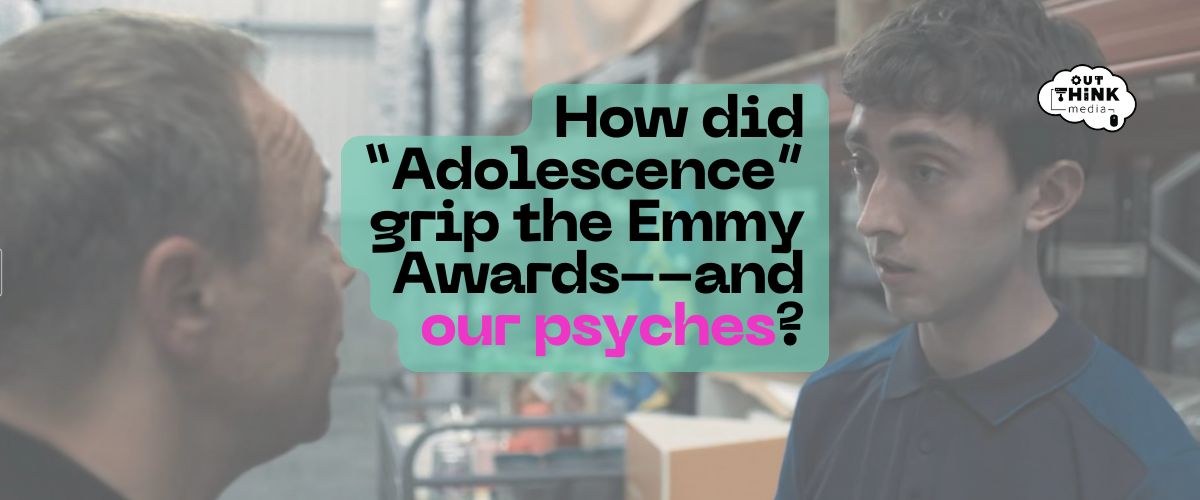
SEPT 23, 2025 – Adolescence, the four episode Netflix miniseries that placed the phrase “manosphere” onto our dining room tables, walked away from the 2025 Emmy Awards with a total of five wins.
It feels to many parents like a deep dive into the manosphere and online symbology, yet even this phenomenal piece of art could only scratch the surface. So why has it entranced so many people across the world, and what can parents learn from the story?
“It should not take a Netflix show for parents to start speaking to their children. It should just be instinct in the house.”
15 year-old Owen Cooper in “Cast Conversation for ‘Adolescence‘ | Conversations | SAG-AFTRA Foundation
Spoiler territory ahead!

This is the moment that gutted me. Image credit: Netflix
“We never learn why.”
Friends urged me to watch this show when it first aired, and ironically I felt too inside the manosphere research hole at the time to do it. (Listen to Out Think Influencers ep1 to see why.)
I need to be honest with you. After watching Adolescence, I was a raw mess, and the very last episode’s concept alone should be heralded as a storytelling masterpiece. Just compare it to the Bluey episode “Hammerbarn” if you need another gut punch.
I kept hearing how “We never learn why he did it.”
We learned why he committed the murder in that moment, but not how he got to that point.
Thanks to the one-shot structure throughout each episode, we cannot ever believe in any moment that there is only one reason. Even in such a disconnected online world, we are still in physical space with one another every day.
Rejection is merely the “why in that moment” — Jamie didn’t emerge on that night of Katie’s murder fully formed, with his own ideas and values. It takes a village, they say, and even the writers didn’t precisely blame the manosphere or incel culture as isolated incidents.
Which is why, when searching for simple answers, we always return to the parents. Yet even there, the Writers and Creators Stephen Graham and Jack Thorne also steered clear of a big reveal to explain anything, like that the father was an alcoholic. We saw tension and relationship foibles within the family, but could not point to any one thing the parents did wrong, either.
“We should’ve done better.”
Out of everything this miniseries brought to light, a parent’s regret will always hit hard. It’s our jobs to nurture our children both physically and emotionally.
So what can parents do? What can we learn from a show like Adolescence? They modeled how to start near the end of episode 2: You must make and maintain connection, relationships.
All of the second episode takes place at or close to Jamie’s school, and was likely the most complex to film, taking the longest to get right at 14 takes. While Detective Inspector (DI) Luke Bascombe had spent all day “fumbling,” as his son put it, to find a motive–one reason why– he makes a very awkward gesture to ask his son out for lunch. The son (gorgeous acting by this young man Amari Bacchus throughout the episode) defaults to not believing in his dad’s sincerity. That’s what he’s used to.
It’s clear from how they speak about/to one another that “just hanging out” is not normal for this father and son. It’s clear how awkward even eye contact between them can be, and that his dad often acts like he doesn’t care enough to be in the same room with his kid. And Dad Bascombe knows it, he understands how his non-desire to have a child is affecting their relationship.
And because of everything that happened in episodes 1 and 2, he now sees how their lack of connection could allow his son to lean into the very influence that Jamie Miller succumbed to. He finally grasps how lucky he is when his son extends an olive branch to decode the sub culture’s symbols for him. He sees how lost these boys are and how it affects everyone, not the least of which is how it affects the girls.
Somewhere between his son unlocking the symbology of their school’s sub-cultures and asking him out to eat, the father sees the gap.
Not just the literal gap, which shows the son in the same position of power that his father normally commands in an interrogation room. You can even quite easily place a long table from the precinct in between them–in that gap:

But the gap we’re talking about first is the gap between what we think our children need from us and what they actually need.
If a parent’s job is to provide safety, comfort, and context to help their kids understand the world, we must also acknowledge the second gap: between how we experienced childhood versus the context in which our children now exist has widened.
But we can’t be afraid of learning their culture, or even live in fear that they’ll be exposed to it! Parents can take active steps toward giving their children the context they need to understand the world around them, and more importantly, be discerning and curious enough to evaluate the media they see.
Let’s not be afraid to make mistakes, either. As Dr. Dana Suskind explained in an interview with Out Think last summer, witnessing an adult take accountability and work through a mistake is great for kids to see:
When parents and children experience missteps, mismatches, and repairs, they create the friction needed to build flexible thinking and emotional regulation. Resilience is built in the cracks, not in perfection. These imperfect moments aren’t flaws to fix—they’re opportunities to grow. Just as our ancestors thrived by adapting, children flourish when they learn to navigate an imperfect but responsive world.
Jamie’s parents aren’t to blame, but they accept fault
For episode four, they followed the Miller Family on the father’s birthday, and I was again worried there would be this big reveal that tries to tie it all together.
But gratefully and gracefully, the ending shows nothing resolved; their path is not rosy nor is it clear. Humans have faults and have feelings and ultimately need to depend on one another.
We consider how family dynamics played into it, and they admit to thinking he was safe in his room. But those circumstances only add up to getting access to material that he could also probably get on the schoolyard. Access is merely the first of four step toward practicing media literacy.
All this new-family of three wants on this day is to have a normal trip to the store. They are all desperate for those small connections to people in daily life that keep us together, that offer a community where we feel protected and not persecuted, where we hold common truths.
And the one human connection the father can genuinely make? A young store employee reaches out to the killer’s dad to show solidarity, believing they hold the same values, beliefs, symbols–the same culture.
That’s when the father starts to understand that this is bigger than their family or the victims, and it’s everywhere. It’s much bigger than Jamie or Katie.
We don’t know what happens after this episode, 13 months after the murder. We know that Jamie’s mom, dad, and sister struggle to connect with one another every day, and they’re working hard at it. They hold out hope their relationships survive “this.”
But until their neighbors and larger community can also acknowledge how important staying connected to our communities are, I fear the Miller family won’t experience much grace.
We can hope that most people who watch Adolescence take more from it than just how bad the internet can be for kids. We are literally not speaking the same language sometimes, if the intent of language is to convey a shared meaning.
We must work harder to make connections to other humans in this new age of siloed lives, especially as our children explore their own influences. Here are some resources to help:
- Listen to my On Boys interview discussing the role that Gamergate and other moments in media history play in radicalizing young boys.
- Watch the Media History podcast episode where I speak to Narrative Game Designer Ben Books Schwartz.
- Listen to Out Think Influencers ep1 to see why it took me this long to watch it. Episode 2 hosts Jen Lawrence of We Fight Cybertime to discuss romance scams for kids, and episode 3 takes us on a journey to discern the Science influencers we can trust.
- Use Pixar’s Inside Out 2 to explain Anxiety to kids
- Read Care.com’s digital literacy for kids by writer Meg St-Esprit
Image credits: Netflix, The Matrix
Read our Fair Use policy.
Discover more from I watch YouTube so you don't have to.
Subscribe to get the latest posts sent to your email.