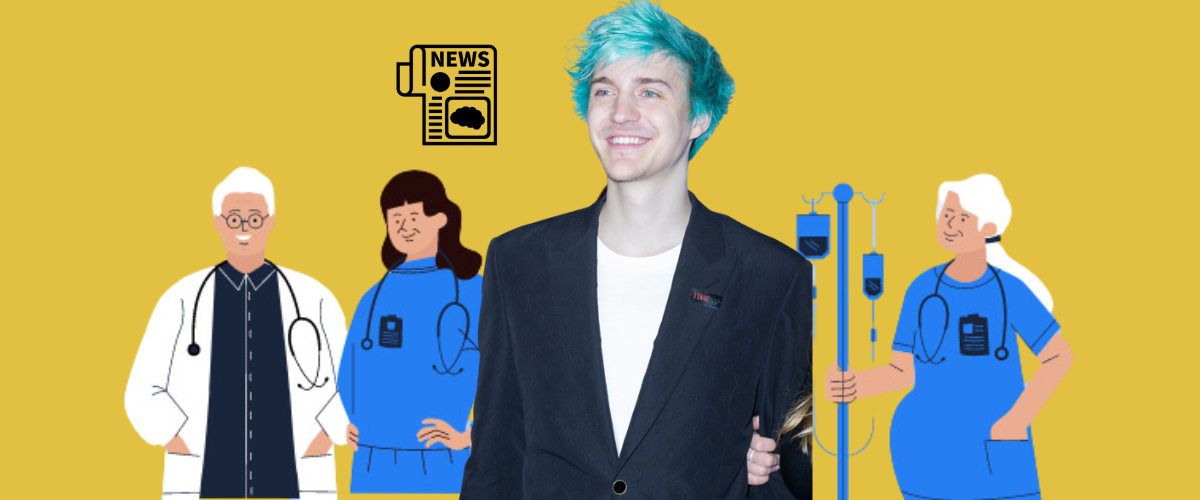
Ninja (Richard Tyler Blevins), one of the most popular Fortnite gamers on Twitch and YouTube and a professional esports player, revealed last week on X (formerly Twitter) that he has melanoma, one form of cancer.
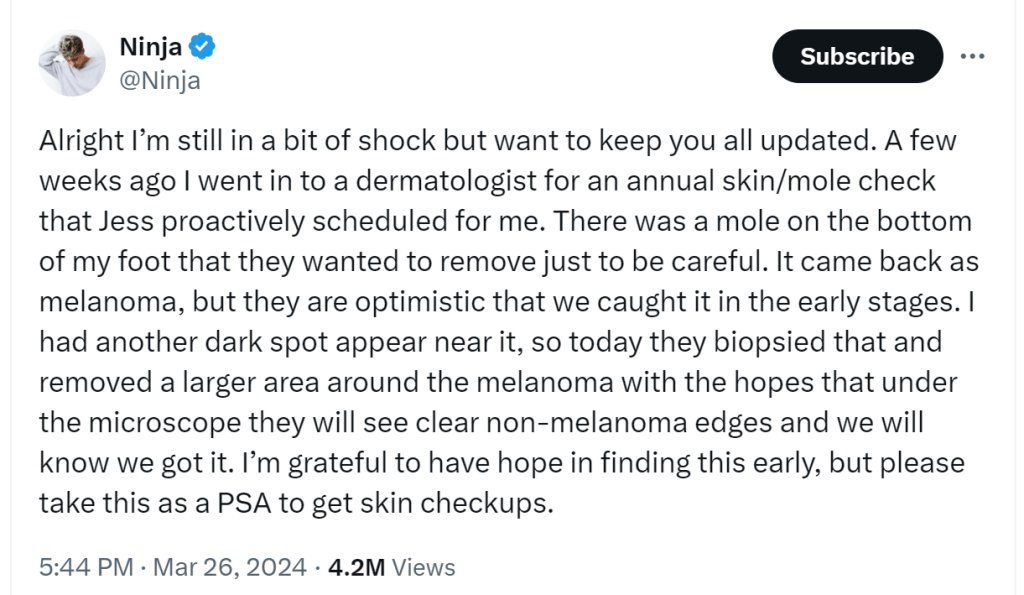
“His X(?) says, “Alright I’m still in a bit of shock but want to keep you all updated. A few weeks ago I went in to a dermatologist for an annual skin/mole check that Jess proactively scheduled for me. There was a mole at the bottom of my foot that they wanted to remove just to be careful. It came back as melanoma, but they are optimistic that we caught it in the early stages. I had another dark spot appear near it, so today they biopsied that and removed a larger area around the melanoma with the hopes that under the microsope they will see non-melanoma edges and we will know we got it. I’m grateful to have hope in finding this early, but please take this as a PSA to get skin checkups.”

When Your Kids Ask About Cancer
The first important message that Ninja relays to his audience is that he is okay for now, even though he has a form of cancer called melanoma. They are waiting for the final analysis of what they biopsied, but you can tell your child that because of early detection, he will likely be fine. An equally important message is to get checkups and not just general health checkups; adults should routinely get cancer screenings.
If they ask whether Ninja will die, you can stress how early they caught his cancer and how he might be able to avoid treatment. More YouTubers have recently shared their journey through chemotherapy, like Hank Green and Grace Helbig.
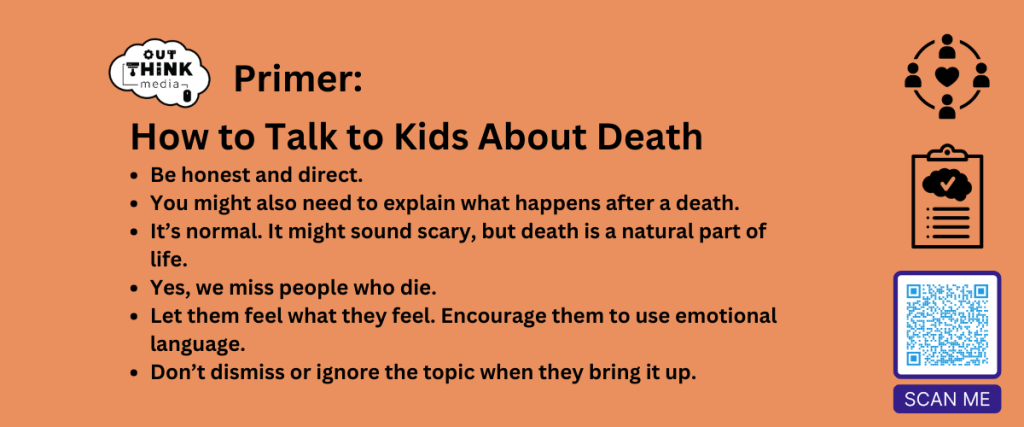
If they ask more and you’ve never talked to your kid about death, we go into more detail in our article on “Death, Grief, The Boy, and the Heron.” Here are the basics, and you can find the full explanations at this link:
Hank Green Explains Cancer
If you don’t know Hank Green or his equally famous brother John Green (The Fault in our Stars, Paper Towns), just trust me: he’s one of the clearest science communicators around. As part of his cancer journey last year, Green was working out how to explain it, and he posted his ideas on his second channel hankschannel. You can watch the whole 20-minute video below, but here is the (very) paraphrased summary that could work well to introduce the idea of cancer:
Ants are just wasps that learned how to work together.
Imagine an anthill. For the ant colony to survive, the entire population in that anthill must work together. Their own individual ant lives aren’t the most important thing; the colony (team) and its survival is the most important thing.
When they learned how to work together, their smell receptors exploded/replicated. These receptors control each individual ant, transmitting messages and signals from the colony, which changes their behavior. This is how the ants’ genes have been programmed to not care about the individual ants, but only the colony’s survival.
Once in a while, there’s an exception—an ant who discovers free will. This single “selfish” ant thinks, “I can just make lots of myself inside of this organism.” It disobeys the colony’s signal and evolves to pass its genes on to the next generation of cells, reverting to a single-celled lifestyle.
With cancer, our cells are the ants, and our healthy body is the ant colony. The cells in our body work together even though it’s not good for any individual cell. What if one of our cells wanted to evolve like that ant to make more of itself and not work for the team? Cancer is when a single cell evolves ways to ignore all those signals and evolves to make more of itself.
There’s so much more, but I like the ant colony description to introduce the topic.
More Resources to Help
If your child is a little older or has an interest in cells and DNA:
The Pediatric Brain Foundation describes cancer like a “mutiny,” combining the idea of the anthill and “bad cells turnin’ against the good ones.”
Read more: Fortnite and Disney? A Parent Primer if You’re Still Unsure
Photo/Image Credit: Cindy Marie Jenkins, Canva, Shutterstock, & X
Sources:
- Green, Hank, “You Don’t Know What Cancer is,” hankschannel, 25 August 2024, https://youtu.be/rCo71uX_pCI?si=1pAxkFhmzkM8gD0u.
- @Ninja, X.com, 26 March 2024, https://twitter.com/Ninja/status/1772741501568569397.
- YouTube Gamers and Gaming Review, OutThink Media, https://outthinkmedia.com/youtubers/youtube-gamers-gaming/.
Discover more from I watch YouTube so you don't have to.
Subscribe to get the latest posts sent to your email.