
We initially launched OutThink Media in November 2023, so it just made sense that we would tackle “A Charlie Brown Thanksgiving.”

I invited my longtime friend Lauren Mazzarese to the conversation, and she has a lot to say about the Peanuts and their ability — or inability– to express themselves through Emotional Language. Mazzarese is a licensed professional counselor with a secondary license in clinical drug and alcohol counseling. She’s been working in her field for about 10 years, and she works with many parents who are trying to figure out their own mental health and, through that, also pass on some better tools to their kids.
And here is where I’m going to remind everybody that you can critique and question art without ruining anyone’s enjoyment of it. Rest assured that if I did not believe that it still holds a place in our modern canon, I would not bother discussing it.
Cindy Marie Jenkins: When I knew I was having kids, I wanted to share these specials that meant so much to me and my childhood. I wanted to share “A Charlie Brown Christmas” and Thanksgiving — and then I watched them again — and I had some questions.
I also don’t think anything in pop culture encapsulates this incredible mythology we’ve created around Thanksgiving other than “A Charlie Brown Thanksgiving” and “This is America, Charlie Brown: the Mayflower Voyagers.“
It made me reconsider the impact of his characters and work and what Peanuts brought into our world.
So let’s get into it. What is your first memory of the Peanuts Gang?
Lauren Mazzarese: The Christmas special for sure. It’s one of the first Christmas specials. I remember watching as a kid, maybe that and Rudolph, but I had a VHS tape that we had taped off of TV of a bunch of Christmas specials. My sister and I must have watched that at least twice a month, every month.
What is Emotional Language?
LM: When I talk to my clients about emotional language, very specifically, it is literally using more descriptive feeling words.
We start with the basics: mad, glad, sad, scared, good, and bad. They’re my least favorite words to describe feelings because they’re basic. They’re good in the beginning, with three-year olds, for example.
But scared, for example, can mean so many different things. It can mean anxious, it can mean embarrassed. it can mean frightened or intimidated, and each one of those has a different meaning. It can lead you to a better idea of what the child or even what you are actually experiencing. So the closer, the more specific you can get, the closer you can get to understanding where the child is coming from, and then how to approach the child and help them so they can use more specific coping skills — then you can validate the child’s feeling more accurately.
And we don’t learn that. A lot of people don’t learn that ever, or even well into adulthood, that there can be a specific emotional language that we can use that just makes it easier for people to understand us, and then help us.
CMJ: There’s a fascinating thing that I had to train myself not to say as a parent, which is when something happens, to say, “Oh, that’s it’s okay. It’s okay.” They’re hurt, but just saying “It’s okay” doesn’t always validate how they feel.
LM: And it is a lot of people’s instinct, I think, to try to ignore what kids are feeling. To make it okay. Nobody wants to see their child suffering. We want to make it okay.
What happens, though, is that the child can interpret that it’s not okay to be sad. It’s not okay to be scared. It’s not okay to feel distressed. And then, when they do feel distressed, that in itself makes them more distressed because “I’m not supposed to feel this way.” And so it is hard. But parents, you, we all just want to make a kid feel better.
The reason why they’re crying might be ridiculous. But for the child who interprets it through the limited point of view that they have just because of their limited years, their limited exposure to even just the outside world.
Whatever it is can be extremely traumatizing or upsetting to them. Whether it’s you know, “Mommy, please, I wanted scrambled eggs.” “Okay, here’s your scrambled egg.” “No, I wanted it fried,” and there’s a meltdown.
Usually, something is going on during meltdowns for kids. It usually means something is happening, and they don’t have the language to tell you. So it just comes out in bursts of emotion. If we could help kids be more specific about their feelings or feelings, it can really help with emotion regulation. That way, there are not those outbursts, and they don’t get so frustrated because they wanted to tell you how they feel they just literally don’t know words.
CMJ: Yeah, I feel like it’s really easy with something like “Daniel Tiger’s Neighborhood,” which I love, I wish I had his mother on speed dial; their episodes are quite literally about “Here’s how you deal with disappointment. Here’s how you deal with this and that.”
Whereas I can only go off all the biographies and everything I’ve been reading about Schultz, he wasn’t going into Peanuts to give parents the emotional language to talk to their kids. Yet one of the things I loved as a kid, and that I’m loving even now as a –somewhat– grown-up, is that his kids talk like adults but still are emoting as kids.
So I’m interested in what looking back at the Peanuts gang, and everything brought up for you.
LM: Oh, wow. Well, personally I and I think that we should share some of this; I could see myself identifying with Charlie Brown and Lucy. Charlie Brown was my emotional life: feeling very left out. There were periods of my grade school years when I didn’t have a lot of friends, and I struggled to make friends. It’s very lonely.
And on the other hand, once I started to find my voice, it was very loud. It’s very directive, and I got labeled bossy, pushy, loud, and obnoxious. Some people were drawn to that, and some people were not.
But I remember also as a kid reading the comics, and I think as a kid, I didn’t necessarily understand exactly what was going on because they did speak sort of like adults. So I see a bunch of kids struggling to express themselves appropriately because they didn’t have language.

You mentioned Linus: he’s very smart in the specials and comics. He knows a lot. He always has lots of information, from philosophy to Bible verses to just arts and whatever it is. He’s also the quickest to admit, though, that he’s not well-adjusted. And yes, he needs it, and in some ways, it makes him better adjusted than some of the other characters because he’s the first to say, “Oh, no, I definitely need my blanket.”
He was the character who seemed most comfortable being uncomfortable, and that’s something I work on with my clients a lot. The world is never going to be perfect. You’re never going to get a hundred percent of what you want a lot of times, and a lot of times, it’s not about fixing a problem or getting rid of the problem or even learning how to deal with the problem. It’s sitting with the problem and knowing you can do nothing. So how can we make you comfortable being uncomfortable? He strikes me as the one who gets the closest to that.
The one thing that strikes me about Charlie Brown that I think it’s a kid, I didn’t necessarily feel was this:
He always starts with hope. Like the football, he’s always like, “This time I’m gonna do it, and there’s this odd determination that he has, although she pulls it out from under him every single time, in the strips and the specials, he has this determination.
His emotional cycle is interesting. I wish I could teach him more emotional language because he starts with this hope, this kind of excitement: the kite song in the musical, for instance.
CMJ: “A little more string, a little more rope. Little more wind, a little more hope!
LM: That’s the thing. He literally says it. “A little more hope.” “I got to get this stupid kite to fly,” and in the song, it does! It flies up, and he’s like, wait, what’s going on? And then, “Oh my gosh, I did it! And then what happens at the end of the song — it crashes, and poor Charlie Brown. It feels like that’s always what’s happening to him, and he has this cycle. I’ve observed where he starts out with this sort of hope, wonder, and excitement, and then he gets bullied, laughed at, teased, and made fun of. He tries really hard, and then, the group. like in the Christmas special, they kind of bring him in.
And then he’s ignored, and he explodes. And then he deflates, and he’s crushed by them. What is odd is he’s usually uplifted by the bullies that knocked him down to begin with.
But what could happen in between there to stop that chain reaction so that he doesn’t get to the exploding part. So he could say somewhere along the line, “You’re hurting my feelings. I’m feeling ignored, or I’m feeling scared or disappointed.” if he could use that language.
And in our real world, ideally, it’s kids using that language to a parent or a peer so that they don’t get to that explosion. Because this is what it would be like for the kids not to have to get to the point where the only way they can be heard or the only way they feel they can be heard is to explode.
CMJ: You know, the very, very, very first Peanuts comic strip, when it was Shermie who was the main character, and an early Violet or Lucy prototype; they’re sitting on a stoop, and Charlie Brown walks by, and they say, “Good ol’ Charlie Brown. Good ol’ Charlie Brown…Yes, sir! How I hate him.”
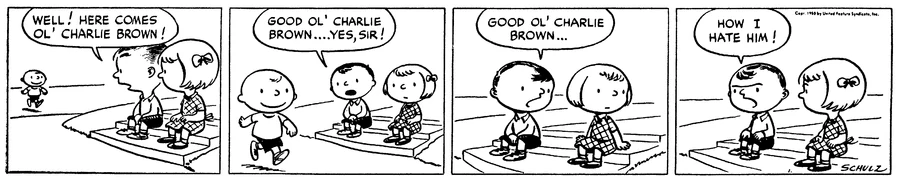
And that’s the punchline! But then they are his friends sometimes. So what if somebody is lonely and bullied? Do you feel they could learn from Charlie Brown, or should parents give the kids a bit of context to help with that?
LM: I think that context is can be very helpful. Actually. I think that media can be great tools for parents because you know kids can watch these shows, and you identify with them:
I feel like that one. I wish I felt like that one. I don’t want to feel like that one.
So having those conversations with kids, watching one of the specials, and saying, “Who was your favorite character? Why, what about that character did you like, or what about that character did you not like?” And then helping them sort of expand on that? Many kids are going to say, “I don’t know.” I don’t know.”
And so that’s again where, outside of that kind of situation, starting to teach kids more accurate emotional language can help. They’re saying they don’t know because, a lot of times, they don’t have the words to explain why.
I didn’t know back then why I identified with Charlie Brown.
But I know now that it’s because I was lonely, and I wasn’t just sad. I was lonely; there was an embarrassment and some shame like I didn’t fit in. It’s hard for a child to understand if they lack a sense of self, but they know when they don’t fit in. They can’t necessarily just say everything they feel. They just know that they feel like Charlie Brown.
CMJ: So I found this amazing thing that Schultz said in Peanuts Jubilee. He said that the initial theme of Peanuts was based on the cruelty that exists among children:
“I recall all too vividly the struggle that takes place out on the playground. This is the struggle that adults grow away from and seem to forget about. Adults learn to protect themselves.”
-Charles Schultz
CMJ: I’m really curious, because, again, we want to protect our kids. The first time my husband and I confronted a bullying incident with our first child, we had to stop and ask ourselves, “Are we reacting to this situation, or are we reacting to the fact that we were bullied?”
So what about if someone’s having trouble making friends? How can parents help their kids if they are in a Charlie Brown situation, and how can they give them that emotional language so the parents can learn what is happening on the playground?
LM: A very good question. You get a lot of information from what you don’t hear, what you don’t see, and what you don’t hear about. So, yeah, if your child’s coming home and you ask how was your day and what did you do, and none of it involves another kid, then that might be a clue that they’re not either making friends, or they’re not interacting with other kids. The question would be, why? Is it because they’re shy? is it because they really are just into kindergarten and could care less whether or not there are other people there, or are they being left out.?
And it’s gonna be hard for the child to say, “Oh, it’s because of this. It can be hard to explain to a five-year-old some more complex words. However, if you can work with media with something like Charlie Brown and say, “How do you think Charlie Brown feels right now?” Start introducing, “He looks disappointed, or he looks hurt, or he looks let down.”
And then talk them through, “Why do you think he feels that way?” And then help your child to put actions they’re seeing with feeling words that go with those specific actions. You can then put that into real life and say, “Are you feeling left out? It must have felt disappointing. It must have felt scary. It must have felt challenging — all of the different words you can introduce.
Use different forms of media to get them to see what you mean. If you’re naming a feeling “disappointed,” that doesn’t mean anything to them. But if you can see Charlie Brown is not invited to any Christmas parties, they can see that and empathize with him, especially if they’re not getting invited to playdates.
Read & Listen to more: The Wicked Witch of the West (Exploring Evil, Ep 1)
Photo/Image Credit: Canva, Charles Schulta
Discover more from I watch YouTube so you don't have to.
Subscribe to get the latest posts sent to your email.

3 thoughts on “Using Kids’ Media to Teach Emotional Language: Charlie Brown”