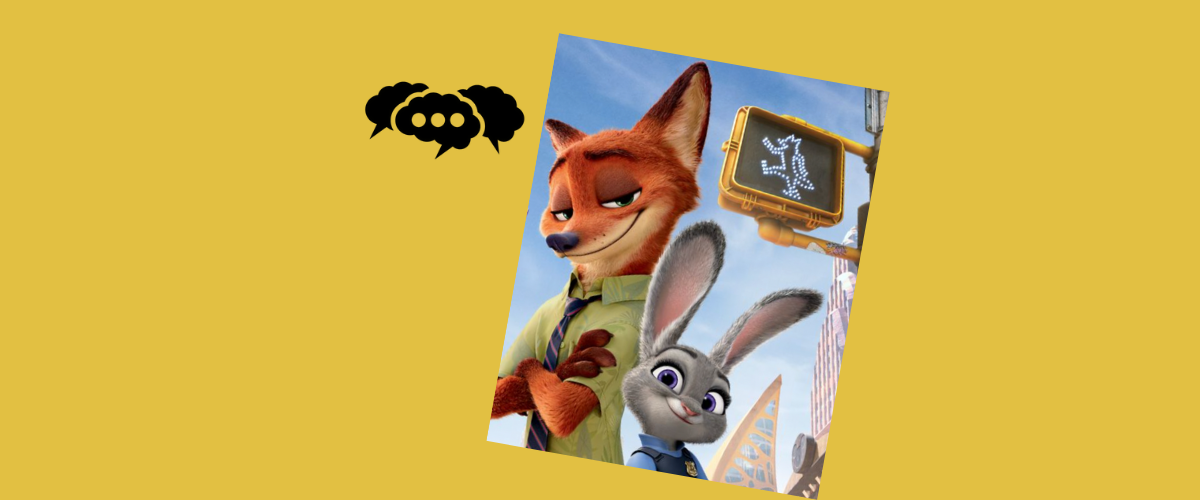
Disney+ recently released six episodes of a new show called Zootopia+. They’re fun, short cartoons very much in the style of the movie, but these are unseen stories that take place during the same timeline It’s almost like they were cut scenes.
So thanks to Zootopia+, we get a little more insight into the somewhat racy relationship between Judy’s parents; we understand how Mr. Big became the Godfather of Zootopia, and enjoy a musical number by Duke Weaselton — and yes, that is the same name of Alan Tudyk’s lame villain in Frozen, so there’s also an inside joke.
Zootopia+ made my kids want to watch Zootopia again. They hadn’t seen it in so long they didn’t remember the details.I’m not going to get into the plot because you can find that anywhere, but there are a lot of conversations that might come out of watching Zootopia. It’s quite a heavy movie wrapped up in a snazzy Shakira/Gazelle song called “Try Anything,” which is now my kids’ anthem.
Dialogues
1. Predator vs Prey
This one is for the younger kids. It can start as a simple description of the animal kingdom. Just watch a couple of episodes of Wild Kratts, and they’ll be experts. Don’t be surprised if your child starts to ask why animals would kill other animals and then you get into the circle of life. They might be nonplussed and move on; they might get upset at the thought of killing animals to eat. In that case, I would wait to show them Babe.
2. Stereotypes and Implicit Bias
Over and over and over again in Zootopia, animals have to face their bias and stereotypes. There are small instancesof microaggressions, throughout the movie, when someone calls our protagonist a “cute” bunny (Judy Hopps nicely explains that is okay for one bunny to call another bunny “cute,” but not okay for someone who’s not a bunny to call them “cute.” To a grown-up, this mirrors the conversations around the “n” slur.
Judy also has to confront her own stereotypes, specifically with foxes. Part of this is because a fox bullied her as a child. Still, it turns out her new fox friend Nick has his own traumatic origin story around being bullied because he is from the predator family: he only wanted to be a cub scout as a child, but the other kids put a muzzle on him and kicked him out. Literally, they kicked him out on the street — it’s pretty brutal, as most childhood bullying can feel.
Nick is not immune to bias or committing microaggressions either; he is fascinated by the assistant mayor’s hair and goes so far as to touch it without her permission, mirroring the microaggression/assault that many Black people face with their own hair. In Simone Aba Akyianu’s excellent article “Touching Black hair as micro-aggression,” she explains how:
“When someone reaches for my hair, it is a signal to others that I am different and that someone is entitled to single me out for that difference. Whether or not it is intentional or mean-spirited, touching calls in other (often unwanted) attention, usually more touching, and sometimes teasing or judgments about how we should or should not wear our hair….More importantly, when such acts move beyond the presumed innocence of micro-aggression, they can become the basis for distinction and the exclusion of Black and racialized folks from education and employment opportunities.”
But the movie offers multiple occasions to start the discussion around stereotypes and how even in a society where people/anthropomorphic animals live peacefully, we all still live with implicit bias. Learning about your implicit bias is healthy, and you may even want to take Harvard’s Implicit Test.
In their article “Understanding implicit bias, and why it affects kids,” Doctors Willen, Ph.D. and Alan, Ph.D. lay out the fundamentals of implicit bias:
- Everyone has them.
- They are “implicit” because they are unconscious and outside of our awareness.
- They begin developing very early and are shaped not only by personal experiences but by direct or indirect societal influences, such as media or news outlets.
- Implicit biases are often in direct opposition to conscious beliefs and values a person may have. For example, you may strongly believe that anyone can be successful in any career, but you still may have an automatic and negative reaction when the nurse who comes into the exam room is a man.
And for anyone who bemoans the “woke” ideology that more recent Disney films offer, I present to you: The Lady and the Tramp, The Fox and the Hound, as well as non-Disney fare like The Secret of Nimh and The Land Before Time. Practically every movie about animals deals with implicit bias; Zootopia simply made it tangible in situations that are more familiar to humans and thus more cringey.
Implicit bias doesn’t always equal prejudice which doesn’t always equal being a racist, but if they’re never confronted then the cycle will never stop. I’d argue that only by identifying our own implicit biases and being willing to discuss them with our children can we slowly remove them or at least understand when they lie underneath our actions or reactions.
2. Dog Whistles: Biology
It takes almost halfway through the movie to get to the actual point of Zootopia, which is that someone has been shooting predators with a poisonous plant to “turn them savage.” When Judy Hopps discovers that the 15 missing mammals are “reverting” to their predator behaviors, she hasn’t yet learned the cause. So she is in front of TV crews’ cameras announcing her discovery, gets flustered when she can’t answer their questions, and repeats what the doctor in the lab and the assistant mayor put in her ear. These predators might be going savage because of their biology.
And this brings up all the fear and all and displaces all of the societal evolution that Zootopia has worked hard to shape. With these few words, in a city with 90% prey and 10% predator, the predators are again feared.
And, like most cringe-worthy moments, Judy just keeps talking. She remembers a play that she wrote as a kid, explaining how it “may have something to do with biology…something in their DNA…thousands of years ago predators survived through their aggressive hunting instincts, for whatever reason they seem to be reverting back to their primitive savage ways.”
So let’s talk about dog whistles, biology, and different races.This tying together of “going savage” and biology could be seen as a dog whistle in our world, but in Zootopia, it’s pretty clear. A dog whistle is typically defined as a coded political message meant for only a small subset of people to understand. The term was only added to the Merriam-Webster dictionary in 2017, but has been around so long that Adam R. Shapiro rightfully states in his Washington Post piece “The racist roots of the dog whistle” how “the fact that this phrase gets used so often is proof that the metaphor fails. Each time someone calls out acts of coded racism as a “dog whistle,” that’s proof that the “wrong” audience heard it.”
But even the dog whistle itself has a racist origin. I know, shocker. Many hunters used it for the reason you’d believe: helping dogs catch more prey. Then dogs were trained to catch slaves during and after the Civil War until they became a symbol of the southern elite. Enter Francis Galton in the 1870s, coiner of the term “eugenics” and author of “Hereditary Genius,” who spent his days at the zoo trying to create an actual whistle to prove that all differences among humans were inherited and therefore could not be improved through opportunities and inclusion. As Shapiro states, “Animal tests were key to his scientific racism.”
Simply put, saying that the biology of different races is responsible for, say, who is enslaved and who is the enslaver is easier for those whose ancestors were in power or who are in power now to stomach than the truth. Like so many other topics, it turns a very complex question (who should be in power and how to make life equitable) into extremely black and white.
There is a lot more to this topic, but I will need to defer to an expert in the future. If you are that person or you know that person, please contact me!
So as difficult as this subject was to bring up while we watched Zootopia, my kids asked what she meant by biology. I paused the movie and asked, “Are you ready for some hard truths?”
They said yes — spoiler alert, most kids want to know the truth about life, good and bad and in between — so I explained to them some of the deeper pain that stereotyping people can get do and how that affects real people. I gave them examples of how this biology misnomer follows people into their doctor’s offices, into laws, and into their classrooms.
Let me reiterate that the very ability to choose when to have this conversation is a privilege for (mostly white) families who don’t experience it firsthand. That’s also an important part of the conversation and one that many ages can understand. With my own kids, I sometimes illustrate it with the toy gun conversation: I prefer that they, two blonde white kids, do not pretend they’re shooting a gun (whether with an actual toy gun or by turning another object into a gun) on a public street or in the schoolyard. For parents whose children have black or brown skin, this is not often a preference, but a necessity for their survival.
Because Zootopia so brilliantly tied it directly into their story, it can be quite easy for children to see it in action, understand parallels in their own lives, and perhaps make it better in the future.
READ MORE: Listen to OutThink the Classics EP 6: How The Grinch Stole His Own Legacy – Dr. Seuss
Sensitivity Reader: Lucy Benton
FAIR USE: Fair use permits a party to use a copyrighted work without the copyright owner’s permission for purposes such as criticism, comment, news reporting, teaching, scholarship, or research. These purposes only illustrate what might be considered as fair use and are not examples of what will always be considered as fair use. In fact, there are no bright-line rules in determining fair use, since it is determined on a case-by-case basis. But copyright law does establish four factors that must be considered in deciding whether a use constitutes a fair use. These factors are:
- The purpose and character of the use, including whether such use is of a commercial nature or is for non-profit educational purposes;
- The nature of the copyrighted work;
- The amount and substantiality of the portion used in relation to the copyrighted work as a whole; and
- The effect of the use upon the potential market for or value of the copyrighted work.
Discover more from I watch YouTube so you don't have to.
Subscribe to get the latest posts sent to your email.

2 thoughts on “New on Disney+: Zootopia+ and the Lessons in Zootopia the film”