I team up with experts to give you the historical, cultural and emotional context needed to understand the state of kids media in 2025 and how we got there.
Local Newspapers & Elections w/ Emily Popek (Out Think Media History EP1)
You can hear tons of practical tips on Episode 1 of Out Think Media History:
Media literacy is never done; it is a lifelong process. Advertisements and marketing inundate our lives, evolving so quickly that you might have already started training your family in media literacy without knowing it.
But how can you tell if it’s working? How can you sustain meaningful dialogues with your kids? I recently spoke with writer Emily Popek on the lessons we can learn from media history, like local newspapers.

Emily Popek is a recovering journalist, school PR pro, & mom to one amazing kid. Popek writes about parenting, education, and why it’s all so f*@#ing impossible at Think of the Children.
The Out Think Team
Cindy Marie Jenkins, Host & Creative Producer
Adam Emperor Southard, Theme Composer (also a fantastic photographer)
Annie Ruby, Podcast Logo Designer
Annie Collins, PR & Marketing Manager
Produced by CMJ Communications LLC, DBA OutThink Media
Dialogue: Headline Literacy
Emily Popek (EP): This sounds alarmist, but I treat all headlines as yellow flags. Literally any headline that I see flash in front of me, my next thought is, let me see if I want to know more about it.
My next thought is: let me see what’s really going on there.
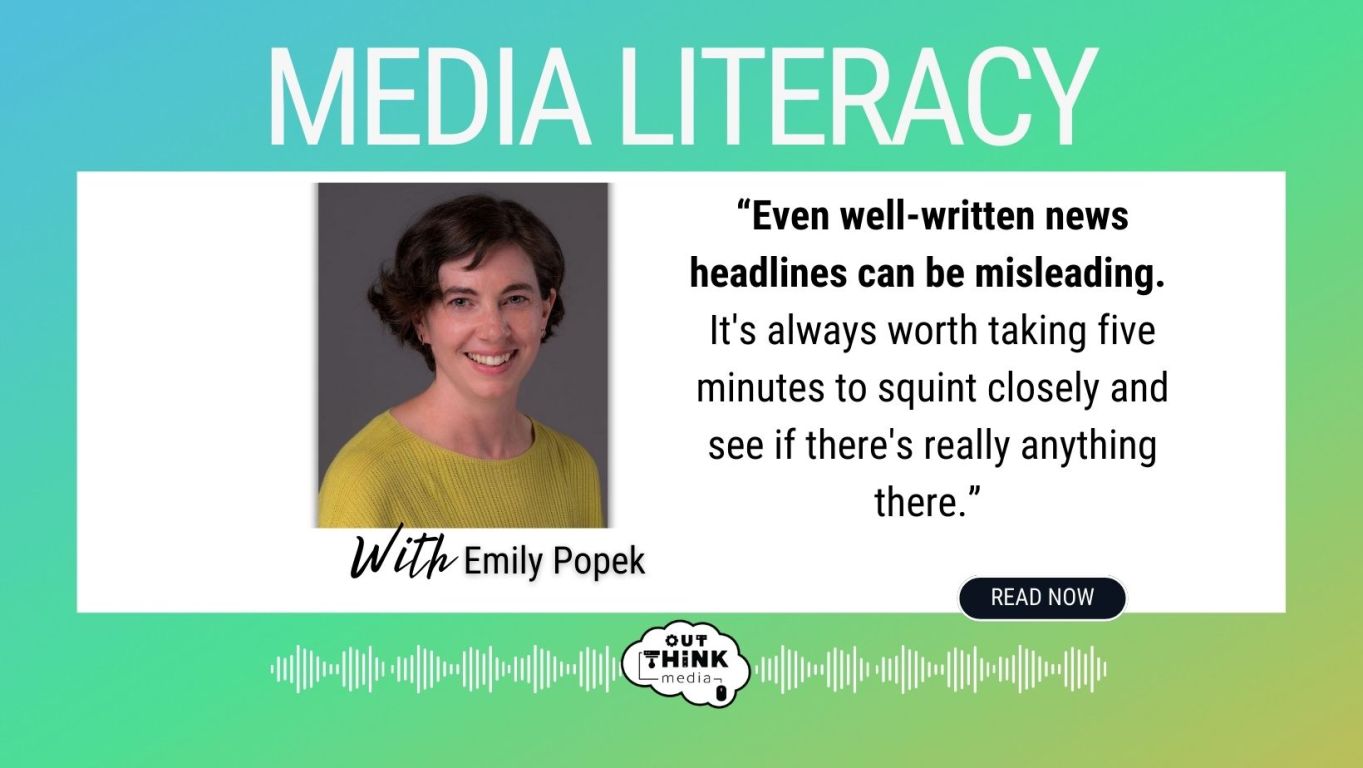
Even well-written news headlines can be misleading. It’s always worth taking five minutes at the minimum to squint closely and see if there’s really anything there. There might be smoke, but is there fire?
Stay cautious with clickbait. I saw a headline about the New York Yankees the other day that made me go, “What?” and I clicked on the link, but the information in the headline was two sentences.
Do your own research. I found a couple more mentions of the Yankees headline, but both were short. That headline made it seem like something really big had happened. This is just one comment someone made. Nothing has really happened.
Make it past the headline before you form your opinion. Make it past the headline and engage your thinking brain with the material being presented to you.
Dialogue: Introducing Elections Engagement
Rather than using one big idea to introduce civic engagement to your family, Popek suggests you “think of it more as lots of little things.”
Make the invisible visible. You, as a parent, probably engage in any number of small or large political acts, you might donate to campaigns, or you might share information on social media.
Talk about your daily or weekly civics actions in front of your kids. Let them hear and see how you are living out your values about this election so that it’s visible to them. That should open up conversations; maybe they heard someone say something at school or saw something online about an issue or a candidate. Then, hopefully, it will prompt them to ask you about it, to say something about it, so and so at school said this, well, let’s talk about that.
Model for my child the difference between facts and opinions and the limitations of my knowledge. I don’t have any problem saying in front of my daughter that I think a certain politician sounded like a jerk when they said X, Y, or Z, or I thought it was disgusting that they did this. Cause those are my opinions. And my daughter is welcome to hers.
I try to stop short of saying this person is this, this person is that. Because that’s a statement of fact, and it’s not being presented as an opinion. And also the limitations of my own knowledge.
“You know, I heard somewhere that the Supreme Court is going to take up this case, but you know what? I don’t actually remember a lot of the details about it. So I’m going to try to read more about that later.”
Model for her that thought process of understanding the limitations or awareness about an issue. And what could I do if I wanted to be more well-informed about it? My husband and I always have conversations like this.
“I heard a segment on the radio about this. But I didn’t catch all the details. Did you hear that? Do you know what’s going on with that? Oh, yeah, I read this article here.” And then we’ll have the conversation. So that my daughter can see in real time how one becomes informed about these issues.
I think those many little things add up to modeling for our kids, “What does it look like to be an engaged political citizen?” And how does our family do this?
What are our family’s values around voting, political involvement, and showing your child where you would seek additional information about a topic if you wanted to learn more?”
Share this post on Instagram, Threads, or Facebook.
Subscribe and follow to hear Emily’s full interview.
Photo/Image Credit: Cindy Marie Jenkins, Canva, & Emily Popek
Discover more from I watch YouTube so you don't have to.
Subscribe to get the latest posts sent to your email.
