

The Teenage Mutant Ninja Turtles (TMNT) were a big part of my childhood. If you know me, you know that it takes very little effort to get me to sing the original theme song. I even won a Halloween contest in my 20s thanks to dressing as Donatello to my friend’s Shredder.
As opposed to the Barbie movie, however, this new film crept up on me, and I barely knew it was coming until it opened. Between nostalgia, Trent Reznor on the soundtrack, and the beautiful animation, I knew I’d enjoy it. What I didn’t expect was to be so touched, and so affected by themes of acceptance.
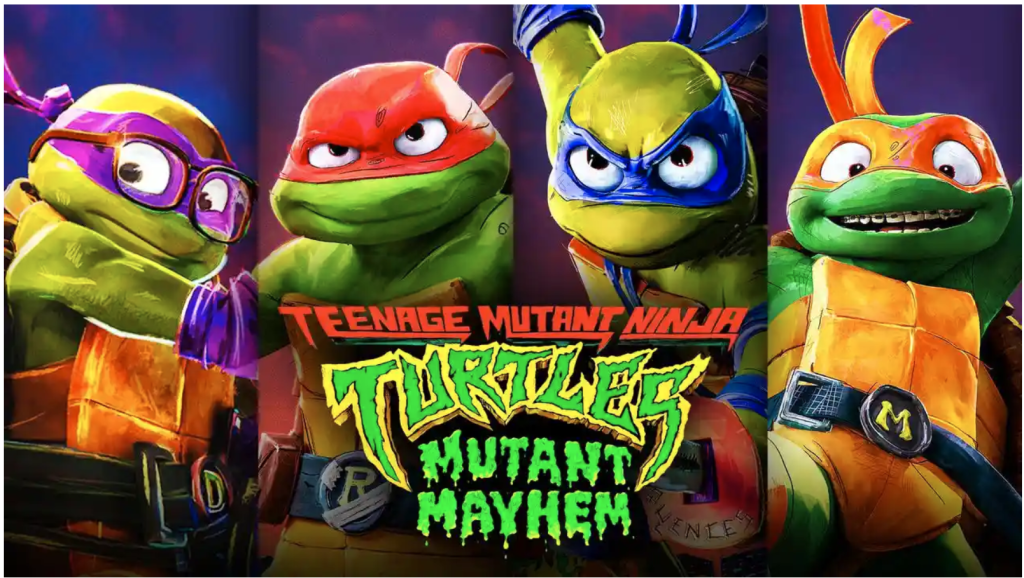
A New Kind of Nostalgia
These turtles, voiced to perfection by real teenagers Micah Abbet, Shamon Brown Jr., Nicolas Cantu, and Brady Noon, still live in the sewers with their foster dad Splinter (Jackie Chan, dressed in all his stay-at-home-Dad glory), but that’s where the known story ends. Even April O’Neill (Ayo Edebiri) perfectly captures a more relevant characterization as a teenage reporter who has to come into her own.
It’s no secret that most of the TMNT canon revolves around family, but I don’t recall an emphasis on acceptance in the 1990s. Let’s turn the spotlight over to kids to talk about TMNT’s themes of Acceptance.

Accepting That We All Want Acceptance
The (actually) teenage turtles in this film are burdened with guilt for wanting to live life above ground while simultaneously honoring their foster dad Splinter’s fear of humans. They think if the public sees them as heroes, they will be accepted into society. It might be one of the first times in modern cinema when the goal is to get into high school and not break out of it.
Feeling out of place and like you have to fit in are as normal to school days as backpacks and boxed milk. How do you find and choose the “right” friends? Author Eileen Kennedy-Moore, PhD, presents us with a list of questions that your kid can ask themselves if they aren’t sure that a group at school is the right one for them:
- What do you have in common with them?
- How do you feel when you’re with them?
- To what extent do you feel like you have to hide or change what you think or do to be accepted by them?
- Do they seem interested in what you think or feel, or do their opinions seem to matter more than yours?
- Can you relax around them, or do you feel like you have to be careful of what you say or do?
- Do you find yourself pretending around them?
- Do they bring out the best or the worst in you?
- When you make a mistake or do something that’s not perfect, how do they respond?
- If you were upset about something, how would they react?
- How do the people in this group usually treat each other?
- How do they treat people who are not in this group?
- Do you like who you are when you’re with them?
-From Kid Confidence: Help Your Child Make Friends, Build Resilience, and Develop Real Self-Esteem by Eileen Kennedy-Moore, PhD, published by New Harbinger

When It’s Your Kid Who’s Left Out
One of my worst fears is that my kids will experience what I did: always being the butt of my classmate’s jokes, putting up high emotional walls and pretending that I didn’t care. The only thing that kept my confidence up was my experience doing theater as a child. Because that’s where my parents saw me the most, they had no idea how badly I was bullied for years. Even my best friend from the age of 5-12, who I knew from our community theater, had no idea.
What if kids aren’t lucky enough to find that kind of escape? Out of all the advice to find on the internet, parents still don’t have a lot of control over whether or not their child is accepted. But we must be there to help them get through it and build their own confidence so when inevitable rejection from their friend circles or social situations occurs, they know they are worthy of love.
- Build up the vocabulary of their emotional language from an early age so your child knows that not only are these emotions normal, but they understand how to name them. You can learn more about emotional language from OutThink Media’s friendly clinical therapist, Lauren Mazzarese, here and here.
- Let them know they can tell you anything, and you will listen. Thank them and acknowledge your child’s bravery whenever they open up to you or another trusted grown-up. Even if they “don’t want to talk about it,” which you’ll hear often no matter how good your relationship is, gently remind them that they can tell you anything, and you want to hear it.
- Then make sure you listen carefully before offering advice. In fact, your child might not want advice. They might just want a loving ear, a place to let out how they feel and what they experienced. They might feel better once they say it out loud. We as parents need to really hear what they’re going through, why they’re bothered or sad, and ask them if they want advice or not.
- Believe and validate everything they feel. Even if you think they’re overreacting, or you’d rather they didn’t play with another kid in the first place, this is not the time to say so. Your child is still up in their emotions and every social transgression feels like it’s the end of the world. Did you ever feel better when adults belittled your feelings and said it was no big deal? No matter why they feel something, it’s an impulse coming from their developing mind and body, and should be both recognized and accepted. Feelings aren’t the problem; it’s what we do with them that lead to good or bad chioces.
- Nurture their own acceptance of others. In Mutant Mayhem, the very ostracized turtle family engage with their fellow mutants while in the middle of battling them. Even though one group wants to save humanity and the others want to conquer it, the turtles found common enough ground to convince their enemies that violence isn’t the answer. Encourage your child to talk with a wide variety of classmates, and form their own opinions about people rather than relying on what their friends think.
- Be their safe space. Children need to know that we listen without judgement, that they can make missteps without punishment (to a certain degree), and that we believe them. If you are lucky enough that your child wants to talk to you, that is a privilege you earned as their parent/guardian. And it can go away at any point if they don’t think you hear them or believe them.
- Understand that we can’t fix everything. Being ostracized at school or made of by friends can’t be remedied with a popsicle or bandaid. Seeing our child hurt is one of the most heartbreaking things a parent can witness; accepting that we can’t fix it is worse. Listen to them, really hear what they’re saying, and ask your child how you can help.
At the climax of the latest Turtles movie, Splinter is shocked when he sees humans banding together to help his adopted sons get out of the villain Superfly’s grasp. This softens his outlook on the world outside his home in the sewers and allows him to release his teenagers into high school to make their own mistakes, to achieve their own triumphs.
If a mutated rat can trust in the emotional foundations he’s given his sons to navigate their social lives, maybe we can too.
Read more: Zootopia+ and the Lessons in Zootopia the film
Photo/Image Credit: Canva, Nickelodeon Movies, & Point Grey Pictures
Sources:
- Kennedy-Moore, Eileen PhD, Kid Confidence: Help Your Child Make Friends, Build Resilience, and Develop Real Self-Esteem, Publisher New Harbinger.
Discover more from I watch YouTube so you don't have to.
Subscribe to get the latest posts sent to your email.
Kennedy-Moore has a Substack too.
It’s called DR FRIENDTASTIC and it also comes with a podcast.
And my favourite Turtle was Donatello.
Some of my friends enjoyed Raphael or Leonardo.